
How to Build a Great Customer Loyalty Program That Drives Engagement and Lifetime Value

Sign-ups are easy. Sustained engagement is not.
In fact, 65% of consumers engage with less than half of the loyalty programs they belong to. Many loyalty programs attract large numbers of members, only to see activity decline within months. Points accumulate, emails go unopened, and what began as a growth initiative quietly becomes a cost center. The issue isn’t that customers don’t want rewards, it’s that most programs are built around transactions rather than experiences.
A great customer loyalty program does more than incentivize purchases. It shapes behavior, encourages participation, and strengthens long-term relationships. When designed correctly, loyalty becomes a driver of customer lifetime value, not just a promotional tool.
This article explores how to build a loyalty program that keeps members engaged, increases frequency, and turns participation into measurable growth.
What Makes a Customer Loyalty Program “Great”
A great customer loyalty program goes beyond transactions. It shifts from rewarding purchases to building emotional connection.
Traditional earn-and-burn models focus on accumulating points and redeeming them later, but this structure often leads to short-term activity rather than sustained engagement.
Modern loyalty programs have evolved into always-on journeys, where members continuously interact with the brand in meaningful ways. In this instance, participation becomes more important than the monetary value of rewards. When customers feel involved (progressing, achieving milestones, or being recognized) loyalty strengthens naturally.
Intrinsic motivation plays a critical role here. Instead of relying solely on discounts, great programs create experiences that tap into curiosity, achievement, status, and belonging. The result is a loyalty ecosystem where members return not just for rewards, but because the experience itself is engaging.
Designing the Best Loyalty Program for Customer Lifetime Value
Customer Lifetime Value (CLV) should be the primary KPI of any loyalty initiative. A program that increases short-term spend but fails to drive repeat engagement ultimately limits long-term growth. The best loyalty programs are designed to increase frequency, strengthen relationships, and extend the duration of customer interaction, not just boost basket size.
To influence lifetime value, brands must reward behaviors beyond purchases. This can be done by paying attention to the following.
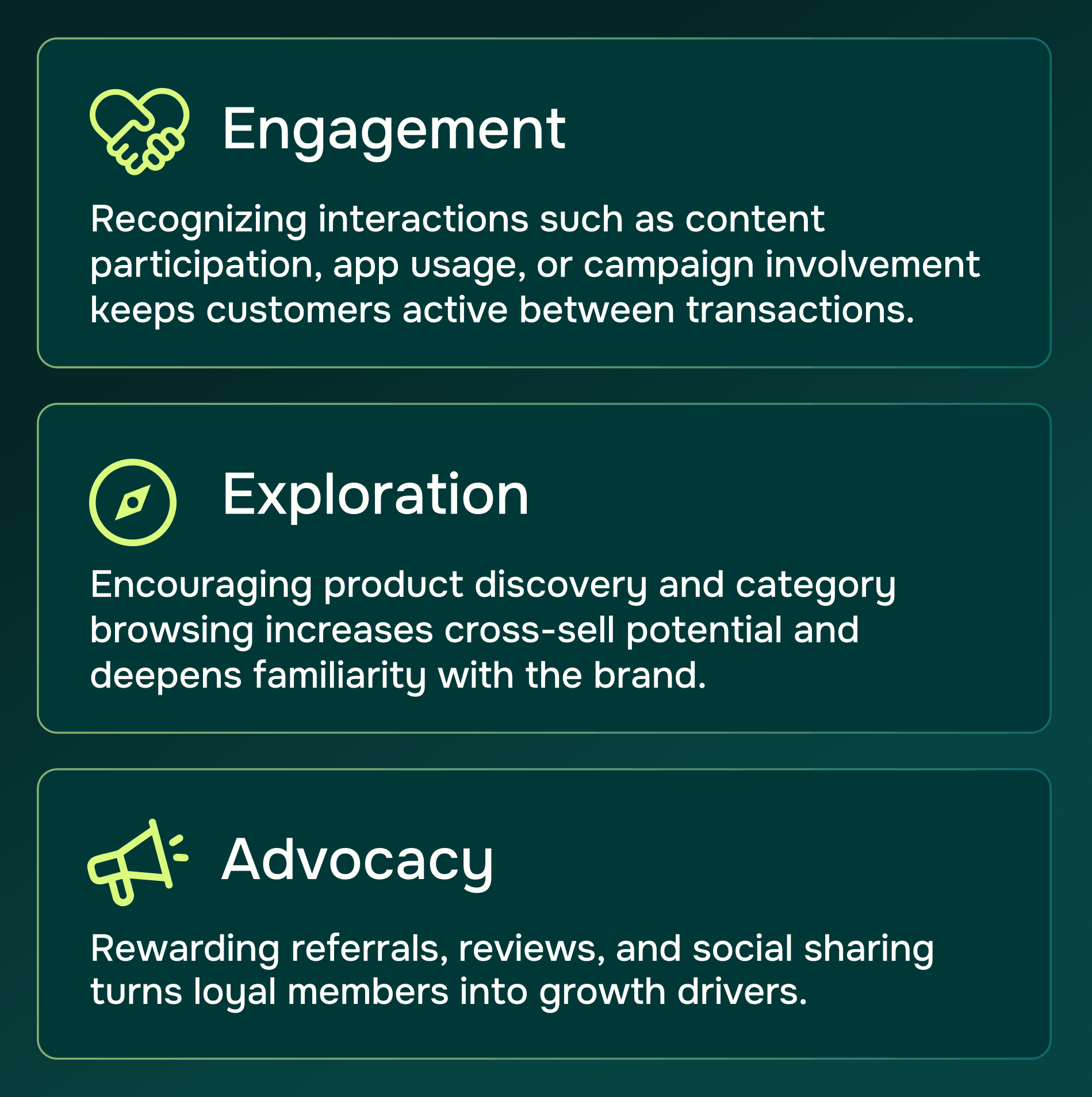
- Engagement: Recognizing interactions such as content participation, app usage, or campaign involvement keeps customers active between transactions.
- Exploration: Encouraging product discovery and category browsing increases cross-sell potential and deepens familiarity with the brand.
- Advocacy: Rewarding referrals, reviews, and social sharing turns loyal members into growth drivers.
Over time, programs that incentivize diverse behaviors build stronger habits, increase retention, and steadily compound lifetime value.
Customer Engagement as the Core of Modern Loyalty Programs
At the heart of every successful customer engagement loyalty program is one defining factor:.
Engagement is the engine of loyalty because it transforms members from passive recipients of rewards into involved participants in an ongoing experience. Traditional programs often rely on passive mechanics such as earning points, receiving emails, and redeeming rewards later, but passive loyalty fades quickly.
Active loyalty, by contrast, invites members to interact regularly through meaningful touchpoints. Games, challenges, progression systems, and visible milestones keep customers invested between purchases. These interactive elements create momentum, giving members reasons to return beyond transactional necessity.
When loyalty feels dynamic rather than dormant, customers build habits organically. Engaged customers don’t need to be reminded to come back, they want to.
Top Customer Engagement Tactics in Loyalty Programs
The most effective loyalty programs use structured engagement tactics that keep members active across the entire lifecycle, not just at the point of purchase.
- Gamified Onboarding: First impressions shape long-term participation. Interactive onboarding experiences introduce members to benefits, tiers, or missions in a playful, guided way, increasing early engagement and reducing drop-off after sign-up.
- Visible Progress Status: Progress-based rewards and status indicators tap into intrinsic motivation. When members can see advancement toward tiers, milestones, or achievements, they are more likely to continue participating.
- Challenges and Streaks: Time-based challenges and streaks encourage repeat behavior within defined periods. These mechanics turn frequency into habit by creating short-term goals with immediate feedback.
- Surprise Rewards: Surprise-and-delight mechanics introduce unexpected recognition. Timely, personalized rewards create emotional connections beyond predictable point accumulation.
- Seasonal Campaigns: Event-driven loyalty activations aligned with holidays, launches, or promotions re-energize the program and create natural peaks of engagement throughout the year.
Customer Loyalty Programs in Retail: What Works Today
Retail loyalty programs operate in one of the most competitive environments, where customers face constant choice overload and high price sensitivity. When alternatives are just a click away, discounts alone rarely build durable preference.
What works today is omnichannel loyalty that connects online and in-store experiences into one continuous journey. Customers expect to earn, engage, and redeem seamlessly across apps, websites, and physical locations without friction.
More importantly, modern retail loyalty links rewards to discovery, not just spending. Encouraging members to explore new categories, try featured products, or interact with branded content increases both relevance and basket size.
Interactivity plays a growing role here, particularly as retail media becomes more important. Gamified touchpoints and interactive placements capture attention more effectively than static ads, increasing engagement while simultaneously driving conversion.
In retail, loyalty succeeds when it enhances the shopping experience rather than interrupting it with another promotion.
Choosing the Right Customer Engagement Platform for Loyalty
As loyalty strategies grow more dynamic, tooling matters more than ever. A modern loyalty program customer engagement platform must do more than manage points, it needs to enable interaction, personalization, and continuous optimization at scale. The right infrastructure determines whether loyalty becomes a stagnant cost center or an adaptable growth driver.
When evaluating platforms, look for the following key capabilities.
- No-Code Creation: Marketing teams should be able to design and launch campaigns without relying heavily on development resources. Agility is critical for testing and iteration.
- Omnichannel Deployment: Loyalty experiences must function seamlessly across web, app, email, paid media, and in-store environments.
- Real-Time Analytics: Immediate performance visibility allows teams to optimize journeys based on live engagement data rather than static reports.
- Behavioral Triggers: Automated journeys triggered by actions, milestones, or inactivity ensure relevance at every stage of the customer lifecycle.
- Flexible Program Models: Support for both always-on journeys and campaign-based activations keeps loyalty fresh and adaptable.
Examples of Good vs. Great Customer Loyalty Programs
Not all loyalty initiatives are created equal. Many brands operate what could be considered good customer loyalty programs, but only a few build programs that truly influence long-term engagement and lifetime value. The difference lies in experience design.
“Good” Programs
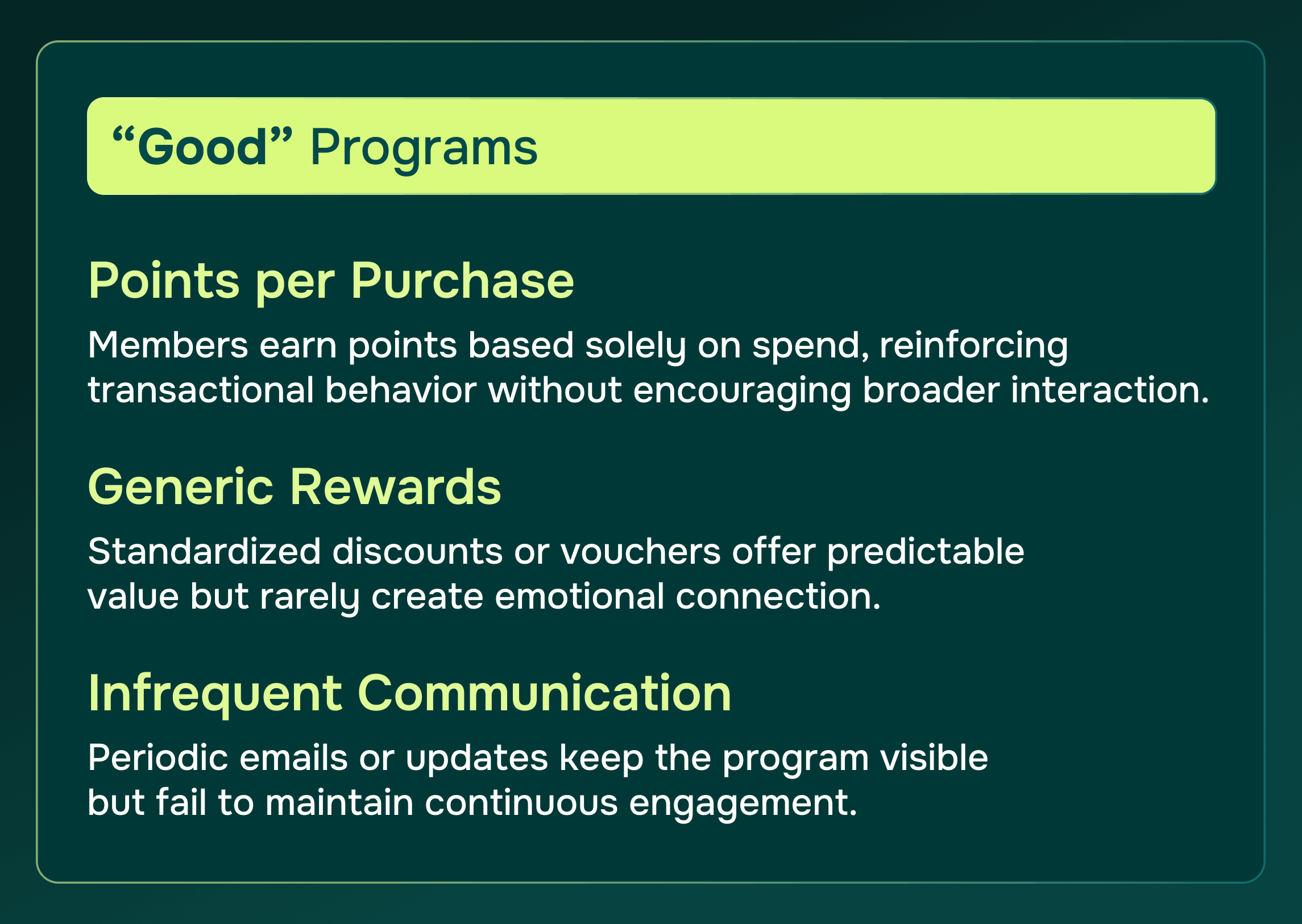
- Points per Purchase: Members earn points based solely on spend, reinforcing transactional behavior without encouraging broader interaction.
- Generic Rewards: Standardized discounts or vouchers offer predictable value but rarely create emotional connection.
- Infrequent Communication: Periodic emails or updates keep the program visible but fail to maintain continuous engagement.
“Great” Programs
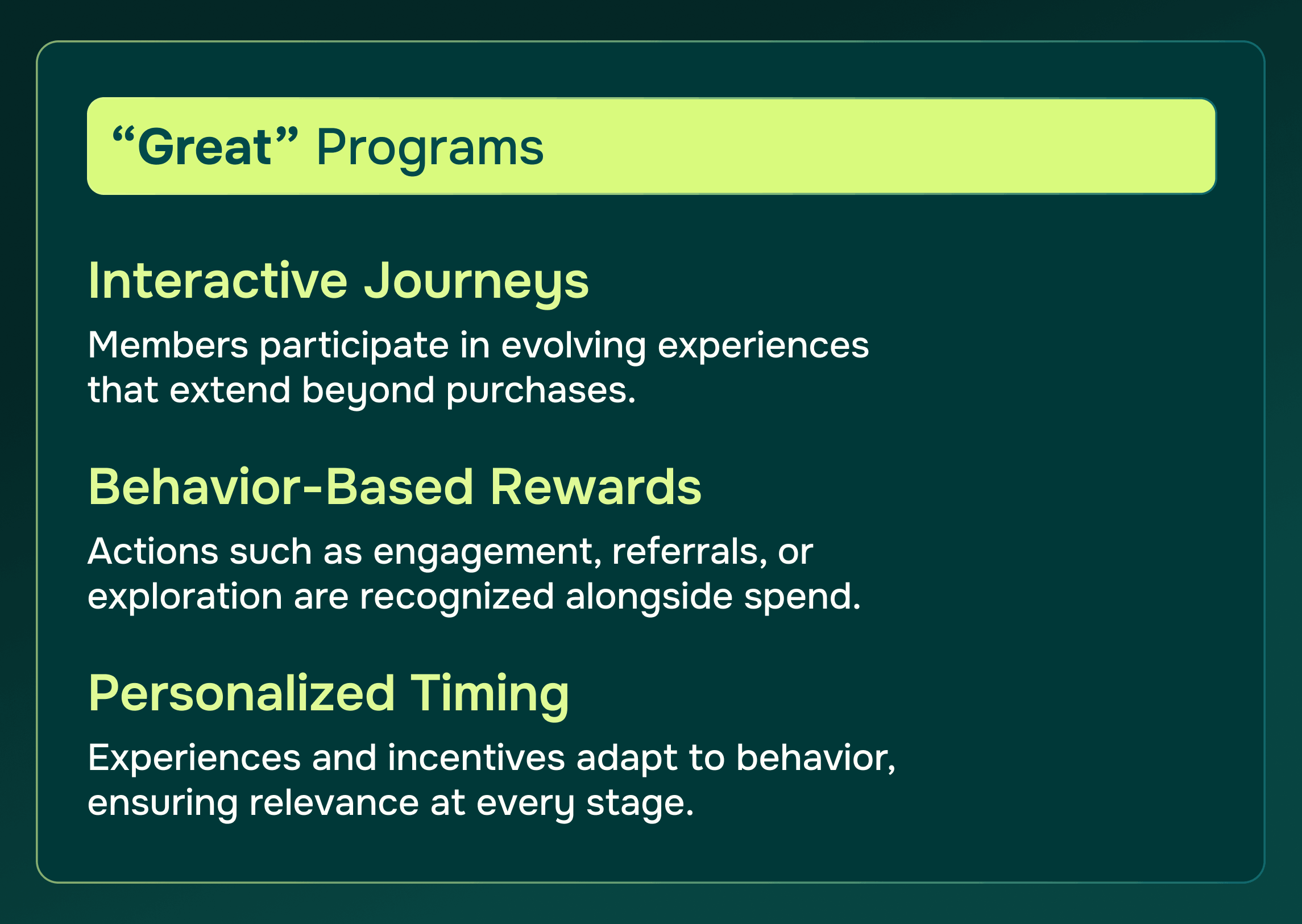
- Interactive Journeys: Members participate in evolving experiences that extend beyond purchases.
- Behavior-Based Rewards: Actions such as engagement, referrals, or exploration are recognized alongside spend.
- Personalized Timing: Experiences and incentives adapt to behavior, ensuring relevance at every stage.
Building Loyalty Programs Customers Actually Want to Engage With
The future of loyalty isn’t about offering more discounts or increasing reward value. It’s about engaging better. Customers are no longer impressed by complex point systems or generic incentives, they respond to experiences that feel interactive, personalized, and worth their time. The brands that win understand this shift. Instead of building schemes designed purely to drive transactions, they create dynamic environments where members participate, progress, and feel recognized.
Interactive, gamified loyalty is quickly becoming the new standard. By incorporating challenges, milestones, visible status, and behavior-based triggers, loyalty programs move from passive structures to active journeys. These experiences strengthen emotional connection while naturally increasing frequency and lifetime value.
Ultimately, loyalty grows when customers participate, not when they simply transact. When engagement becomes the foundation, retention and revenue follow.
If you’re ready to transform your loyalty strategy into an interactive growth engine, get in touch with BRAME to request a demo to see what’s possible.

Make your play to `engage, convert and retain today`
Speak to an expert and start leveraging best practices and winning industry-specific Gamification strategies with our Builder.
Name of the heading
`Make your play` to engage, convert and retain today
Speak to an expert and start leveraging best practices and winning industry-specific Gamification strategies with our Builder.
Discover More Insights
Ready to dive deeper into Gamification Marketing? Engage, convert and retain more customers with our latest learnings, proven over 10,000+ campaigns.

How to Increase Customer Retention in Marketplaces: Strategies That Actually Work
Marketplaces are built to scale, but that scale often comes at a cost. In the current market place acquisition costs are rising, conversation rates are decreasing, budgets are shrinking and loyalty remains fragile. In marketplaces, retention isn’t just a performance metric, it’s a growth multiplier.

E-commerce competition is heating up—here’s how to increase online sales to stay competitive
In the ever-evolving world of e-commerce, brands are facing down a new threat from an old enemy, and it's messing with your favourite metrics. People appreciate being bombarded with marketing that misses the mark less than ever—businesses even sell ad free experiences as features and build their pricing around it. Where does that leave marketers?

What Is Ecommerce Gamification? A Complete Guide
There is an entire business ecosystem of goods, services, and experiences sold or traded online. Digitization in all its forms is increasing and changing how people do everyday activities, such as buying groceries or paying fines.
"We became more cost-efficient and the drag and drop Builder is just awesome!"
See what Marc Marti from Tchibo and other leading marketers had to say about BRAME.

Marc Marti


Elena Abeltshauser


Luca Cadlini

This is more than a promotion — it’s the beginning of a new gamified customer experience. We’re excited to introduce fun, interactive ways for our guests to engage with the brand, earn rewards, and discover new reasons to visit their neighborhood District Taco.


Through Gamification, we reach customers on a different level and can surprise, inspire, and reward them. We are seeing an increase in frequency and revenue as well as enhanced engagement from users of our digital channels.

I can highly recommend BRAME's Gamification tool to anyone looking for a cost-effective and simple solution to collect email addresses or increase sales

The real-time performance analytics are very important to us, as they allow us to take our learnings and refine our strategy for upcoming campaigns.


In an A/B test, we displayed a Gamification banner to half of our website visitors, while the other half saw no banner. The group with the Gamification banner achieved an 18% higher sales conversion compared to the group without it. This was an outstanding result for us, as only very few tools or methods can boost sales conversion by 18%

With BRAME’s user-friendly software, we have been able to successfully implement a variety of campaigns and now see Gamification Marketing as a key component in our marketing mix.
What I appreciate most about working with BRAME is the drag-and-drop Gamification Builder, which made it easy for us to implement Gamification Marketing, along with the expert advice and support based on industry-specific best practices. This enabled us to launch a successful Gamification campaign and implement game mechanics perfectly suited to our industry and goals.

All the games have worked well so far. The Advent calendar is a yearly highlight, and customers are already anticipating it. The cost is much lower compared to the agencies MPREIS previously used to create a gamified Advent calendar.

In the last 20 months, we’ve collected over 35,000 unique leads and achieved a double opt-in rate of over 70%, which is more than double the industry average.
We had previously worked with agencies in the Gamification field, but with BRAME, we’ve become much more flexible. [...] We need much less time to set up campaigns, have excellent support that we can rely on, and are incredibly fast in execution.
The drag-and-drop functionality allows for quick game creation without technical expertise, which is especially valuable for day-to-day operations and to save time.
The diverse selection of game types and fully customizable templates provided by BRAME's tool allow us to create new experiences every time.
Users were motivated to repeatedly participate in games through gamified marketing campaigns, increasing the digital engagement and driving more frequent purchases.

Through our gamified campaigns with BRAME, we were able to generate numerous new app downloads and welcome new SPAR Friends members to our community. BRAME has made a lasting impression on us, and we are looking forward to various other campaigns.

During the European Championship, the Hit-the-Target Gamification Marketing mechanic increased sales conversions by 44% between June and July compared to January to May 2024. Additionally, the average card size grew by 11%, and transactions increased by 21% during the same period.

Compared to previous third-party providers, BRAME offers us a more flexible tool and the ability to independently create campaigns at a considerably lower cost.

Through a social media campaign with gamified content, we generated 14,000 leads, with 25% signing up for our newsletter via double opt-in. We were amazed at how easy it was to generate high-quality leads with Gamification Marketing in just four weeks. Simply perfect!

Don’t play around. Play to win.
Speak to an expert and start leveraging best practices and winning industry-specific Gamification strategies with our Builder.
- Flexible Pricing
- Impactful Results
- Easy to Use
.avif)


